How the Director of BTS: The Return Captured a Band in Transition
“It felt like The Odyssey,” the documentary filmmaker Bao Nguyen tells GQ. “BTS was Odysseus, and ARMY was Penelope longing for the return.”
By Raymond Ang
March 27, 2026
Over the past decade or so, the Vietnamese-American filmmaker Bao Nguyen has made his reputation on incisive, compulsively watchable documentaries that unpack a wide range of cultural phenomena.In last year’s The Stringer, for example, Nguyen interrogated the authorship of the famous “Napalm Girl” photo and its implications on the Vietnam War. In 2020’s Be Water, the filmmaker untangled Bruce Lee’s legacy within the context of the systemic racism he encountered during his career. Nguyen’s range extends to poppier projects too, like TheGreatest Night in Pop, which took viewers through the making of the star-studded hit “We Are the World” and Live From New York!, which traces Saturday Night Live over four decades.
Those storytelling skills are now being showcased in BTS: The Return, his buzzy Netflix documentary that follows the biggest band in the world as they recorded their new album Arirang and prepared for their much-anticipated comeback.
Going beyond the frictionless hagiography of recent pop music docs, The Return is a snapshot of a band in transition, the seven members of BTS wrestling with questions of authenticity, relevance, and nationalism while laboring under the pressures of delivering their first studio album in nearly six years. The documentary is out today, exactly a week after Arirang’s release, providing perfectly timed context to their latest full-length statement.
In one thread that runs through the documentary, for example, we watch the band wrestle over the sample of the traditional folk song “Arirang” that would eventually feature on the track “Body to Body.” There’s genuine tension when the members debate the implications of the length of the sample—too long and it might seem tokenistic, too short and it might dilute its impact. (The discourse climaxes in a meeting with Hybe chairman and founder Bang Si-hyuk, who argues for the power and significance of the longer version.)
Ahead of the release, Nguyen talked to GQ about the long road to making the documentary, being a fly-on-the-wall while BTS had passionate debates about creative decisions, and how he earned the trust of the seven members to tell their story through the film.
GQ: It’s so interesting to me that you’re going from your Vietnam War documentary The Stringer to The Return, a documentary on BTS. How did you end up working on this?
Bao Nguyen: It was a long journey in many ways. I went to one of their SoFi shows back in 2021. I was planning to go to one of the Rose Bowl shows in 2020, but sadly that tour was canceled or postponed. When I was able to finally see them live, it was such a surreal and emotional experience in many ways.
I’m always thinking about stories. They do these long conversations with ARMY and the crowd. They were so touched by the response from the crowd, preparing their sort of farewell, and talking about their upcoming military service and their time away. It was really touching. And I saw how emotional ARMY was getting. And for me, it felt almost Homeric and mythical in many ways. It felt like The Odyssey. BTS was Odysseus, and ARMY was Penelope longing for the return.
I floated this idea to some people at [the entertainment company that BTS is signed to] Hybe. I was like, “There’s something there that I think is an incredible story that really stands the test of time.” And it didn’t work out immediately. There’s a lot of secrecy, and rightly so, with military service. A few years later, they’re like, “Well, the group is out of the military. Would you be interested in coming back and documenting their return and the creation of this album?”
Funnily enough, I was very busy at that time. The Stringer got bought by Netflix and we were just making some updates to the film because it was a developing news story. I was like, “Oh, do I have time to do this?” It’s such an incredible story. And it’s something that was marinating in my mind for a few years.And what I was really interested in was this snapshot in time of the band. I didn’t want to make a retrospective—I walk in a long lineage of filmmakers and storytellers who have been telling BTS’s story since they started. I was like, Okay, if I’m offered this privilege to tell this story about their return, I have to take that opportunity.
You capture the band at a very interesting, exciting time of transition. I love this line RM said in the documentary: “We have to decide what to keep and what to change. We’re doing a lot of experiments to try to find out what makes us special, what makes us BTS.” Did you go into production knowing that that was their state of mind?
Not at all. I came in with sort of an assumption that artists who are at the top of their game just go into the recording studio and just nail it every time—which I should know better because I made a film, TheGreatest Night in Pop, about the making of “We Are the World,” where you see the greatest icons of music of that time being very nervous and anxious.But there’s sort of a stigma of K-pop that everything is very manufactured, and everybody’s perfect and polished. But what I saw coming in for the first few days was the sense of pressure and tension and a lot of questions. And that was, frankly, very surprising for me.As a filmmaker, though, as a storyteller, I was like, “Yes, this is great. There’s actually some drama here.” But I was expecting it’d be a pretty sort of tight, refined process because we came in slightly later in the process as well.What was meaningful for me was for this film to start when Jin came back from his solo tour. We did film beforehand, and we gave the members their own camcorder. I wanted them to kind of get their own perspective on the process and be really intimate because I knew that I wasn’t going to have access to them 24/7.The film sort of begins linearly when Jin arrives. But as we know with film—and as RM says very eloquently about Kairos and Chronos—you’re sort of stretching time. Even though the film might start with Jin’s arrival, what we captured in the story is more than just that.
You were talking about how the documentary crew wasn’t there 24/7. How long did you actually have to shoot this? And then I’m curious, in terms of the crew being in the house, what was that schedule like?
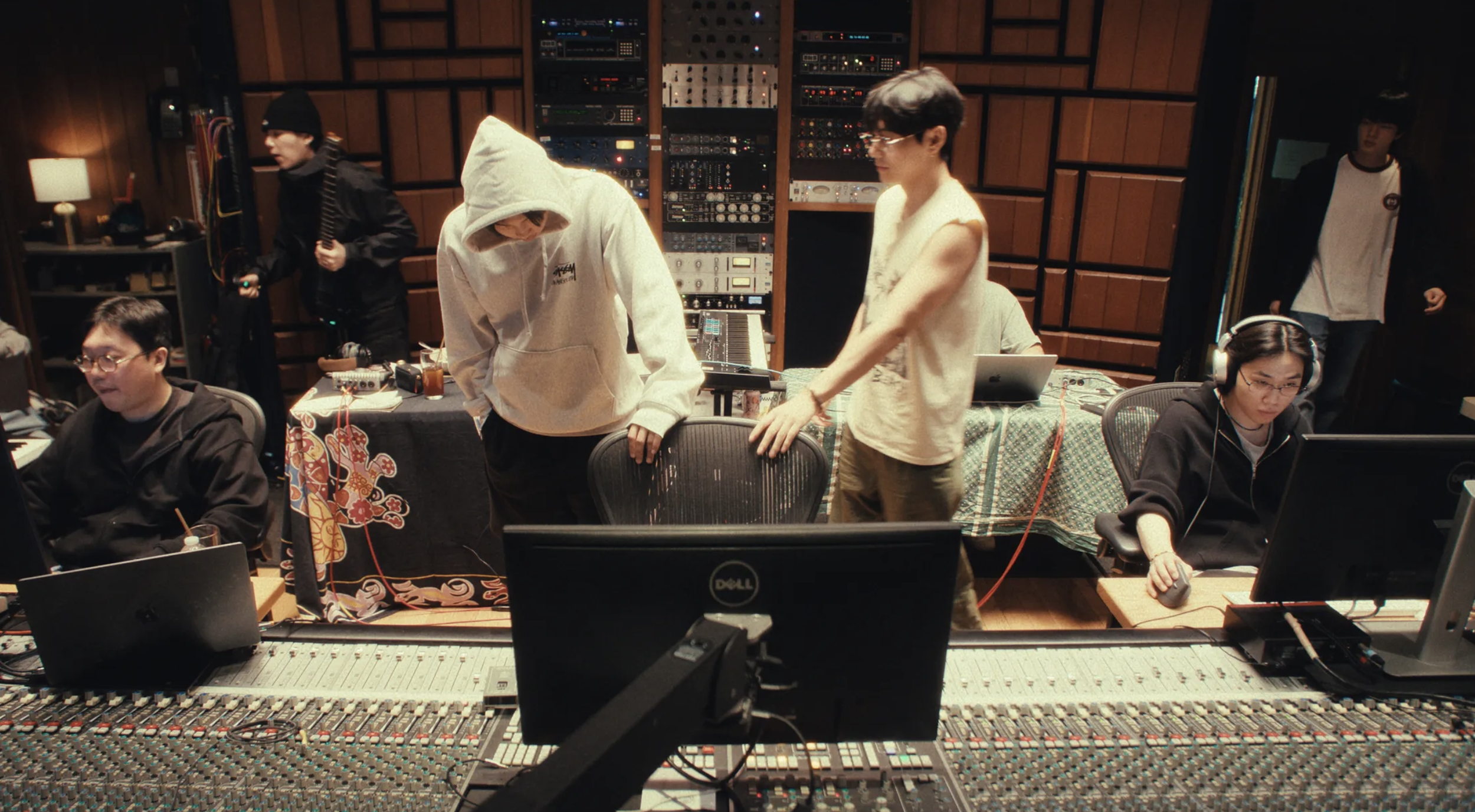
I think over most of the summer and the fall, I was filming the project.Certain filmmakers might want complete access, but for me, getting complete access is not giving the space that the participants and someone who’s in the creative process the time, and breadth that they need to actually be intimate with the camera. I worked with the label and our wonderful Korean partners at Hybe to figure out what the story I wanted to document. And they were very open in telling me, “Well, this is what they’re doing on this day. This is who they’re recording with,” so it wasn’t just this reality-TV catchall of every single moment, but it was very intentional of what we wanted to film.And they had a routine. They were working six days a week. They work out every day, essentially. And then, 1:00 p.m. to 8:00 p.m., they’d go to the studio, and then they would come home and sort of relax and chill with the group. For me, I didn’t want to intervene on that ritual, that routine, because that’s not my position as someone who’s observing the creative process and their comeback. I would just, again, talk to their team about what they’re doing within that time period and try to capture those moments as much as I could.
One of my favorite things about the documentary, and what I think really makes it special, is how it captures the decision-making process around the sample of [the traditional Korean folk song] “Arirang.” As a viewer, I thought it was a really interesting case study of how they make creative decisions as a band. Tell me about shooting the moments that threaded that together.
I think what was fascinating about that process is seeing how unique each member’s opinion was on each. Originally, J-Hope and Jimin were really into the sample. And then you see V just curious, questioning, “Oh, what do they hear that I don’t hear?” And it’s just in that glance. And then RM comes in.I really love that scene because, just within that scene, you see the evolution of what they’re debating. And it also speaks to the larger theme of what they represent as BTS, as Koreans, into the world, but then as artists too.That was something that I learned so much about that I wasn’t expecting to be such a theme and conflict in the film, the idea that they don’t have just the weight and pressure of being these huge artists, but they have this huge pressure of also being cultural ambassadors representing Korea to the world. And I think that sort of burden—or privilege, you might say, depending on your perspective—is so unique to them and many international artists who have to travel abroad. I think [this happens] less so in Western countries, to be honest.
How did it feel to be in the room when they were having those debates?
I mean, it’s funny because they were having the debates in Korean. I’m Vietnamese American, but props to the production team because we workshopped all the different ways that I could receive live translation. I had an in-ear piece, while our translator was in another room listening to the audio.There’s seven guys talking at the same time. And they talk. They have opinions. I told the translator, “You have to say who’s talking,” because RM says this, and then Jimin says this. Because otherwise, I just heard this cacophony of opinions. But I could tell, for me as a filmmaker, as a visual storyteller, I was very keen on just seeing people’s facial expressions and their body language and sort of turning the camera when I felt like, This is a moment of tension. This is a moment of relief.Documentary film is often found in the edit too. We had an amazing team of editors who spoke Korean. We basically found every Korean-speaking editor that we could in America. And we had such an all-star team in postproduction because we had such a kind of compressed schedule. But I was really able to shape it with them in the edit. But in the moment, you’re just trying to sort of feel instinctually where the scene is going. And we were shooting mostly sort of locked off on Zoom lenses because I wanted to be as unobtrusive as possible. There were some times we were handheld. But for the most part, me and my cinematographer, Caleb Heller in LA, we were just backs-against-the-wall, just shooting, trying not to be obtrusive.
There are moments that you do seem to engineer as a director. There’s that scene where we watch the band watch the old footage of themselves in the home theater, and they’re getting visibly moved. And just this uncanny thing of ARMY watching the band watch their old selves. It’s very cool. What made you want to do that?
Well, they had many different types of recreation rooms in the house that they were staying at, and one was a screening room. I asked them, “Oh, how often do you go down there?” And they’re like, “Sometimes, but not too much.” They actually watched Greatest Night in Pop down there—some of them [at least], I don’t know if all of them together.I was like, “Oh, it’d be fun, if when Jin gets back, you just sort of reminisce on your last shows.” And they were totally down to do it.Again, the film is such a specific period in time of their long career. It’s funny to say “long” because they’re still so young, but they have a very storied history. I wanted to somehow show the passage of time with this archival footage to give some context to the viewer, who might not be ARMY, who don’t know their kind of full trajectory. And it was also a chance for them to reminisce on the past and especially their time in Los Angeles.
We gave them these camcorders, which I wanted to evoke the style of your dad picking up a camcorder and filming your vacations, your family vacations, and sometimes some of the best moments with me and my loved ones is watching those videos, in a way. That felt like a family watching their old home videos.
I love that. I mean, earlier you were talking about the lineage of concert films and reality shows that they’ve done in the past, and even the fan-made documentaries like Rise of Bangtan. How do you see this interacting with the ARMY canon?
I feel really privileged to be able to document this specific moment in their time. I know that they rarely work with outside filmmakers. And I think it’s sort of indicative of how they wanted the album to be represented, working with a lot of people that they haven’t worked with before going to Los Angeles. I think, in a way, life was imitating art when we were collaborating on this project. But it’s hard to say because the film hasn’t come out yet as well, to think about where it belongs in the canon. I will let ARMY decide on that one, but I hope that people enjoy this moment and understand that it’s a moment, it’s not meant to be definitive or sort of a retrospective. But it sits between—in the liminal space, in a way, of their journey. And I do hope that ARMY loves it for many reasons, but I also hope that people who aren’t ARMY, who are coming to BTS new, respect the work ethic, the determination, the passion of these seven young men and just the act of what it means to return to something, to return to yourself, to return to your family, to return to your dreams in many ways.
As BTS, they’re such a united unit, they’re so strong. But at the end of the day, they’re also seven unique individuals. And especially at the time you shot them, they were all coming from their own different journeys and solo careers. I’m curious how you approached winning them over, to get everyone’s trust or buy-in for the project.
I mean, there was a lot of letter writing. I was just sort of explaining why we’re making this documentary, my creative intention for it. You have to earn the trust of the participants of your film. And I often say I’m not making films about people. I’m making films with people. I wanted them to feel like this was a collaboration. Obviously, it was someone outside looking in, but as the filmmaking journey progressed, they felt like they understood what the themes of the film were.As with any film where you’re coming into things new, I think one of the beautiful things about being a filmmaker, especially a documentary filmmaker, is that you’re allowed into a world that you don’t necessarily belong in, and you’re given this access. Again, I think of it as a privilege to document and tell the story of your participants.
It was a slow burn. I mean, again, as you said, there’s seven unique individuals with seven different perspectives and characteristics and temperament. Some people were much more open at first than others. But by the end, everyone was.
They would always make sure I was doing okay, that the crew was doing okay. It’s funny because we’d shot so many dinner scenes at the house. I was also one of the cinematographers on the film, so they would hear my stomach growling while I was watching them eat, and they’re like, “Just come and eat with us.” I was like, “I can’t. I’m making a movie here.” [Laughs.]
But after we wrapped, we’d have a drink together. And immediately when I got home, I’d order a Korean barbecue because I was so hungry and inspired by their dinners. [Laughs.]
I love that the documentary starts off with “hello,” which feels like a reference to Jin’s famous “hello” that has been analyzed to death by ARMYs. Was that a wink to the fans?
There’s a lot of winks to the fans. I think I was just capturing the moment when he’s coming in the door. It’s just that’s a moment. And again, within their personalities and within the things that they do, I think they’re winking to ARMY in a way.
There’s a thread that runs through your work of trying to get to the heart of a cultural phenomenon. I mean, even in something like The Stringer, that’s still the phenomenon of the [“Terror of War”] photo. And then of course, Lorne Michaels and Saturday Night Live on Live From New York, and obviously “We Are the World” in Greatest Night in Pop. How do you see BTS falling in that lineage? This might be an assumption, but looking at your work, it seems like you’re trying to make sense of why a culture falls in love or is entranced by something.
I mean, that’s exactly it. I think I love to make films about culture and iconography because those are the things that we as a society choose to celebrate. And by that choice to celebrate something, it reveals something about who we are and why we choose to celebrate something.
With this one, it happens to be the biggest band in the world. And it goes back to when I was at SoFi and seeing that connection and relationship between ARMY and BTS that was mythical. It’s something that, through millennia, you see that longing, that longing for someone you love when they go away and waiting for them to return. I think, in a way, by looking at what we celebrate today through culture, it allows us to look at how we connect to the past as well and connect to these stories and these mythologies and these emotions that will always make us human. No matter the time or space, these are the things that ground us.
And then my last question is, do you remember the first time you heard of BTS?
I can’t pinpoint the exact moment. I was living in Vietnam when they sort of blew up. I lived there from 2012 to 2018, when they were getting big. I recall someone making a rumor that they were possibly going to perform in Vietnam. I kind of was adjacent to the music industry there. Vietnam loves K-pop, and so I think that was just the rumors of them coming. I started listening to them a bit more and slowly grew in my admiration for them. And it really sort of reached its peak or its initial peak when I got to see them in concert because that’s such a unique and emotional experience, for sure. If you’ve never been to a BTS concert, go to a BTS concert if you’re able to.